


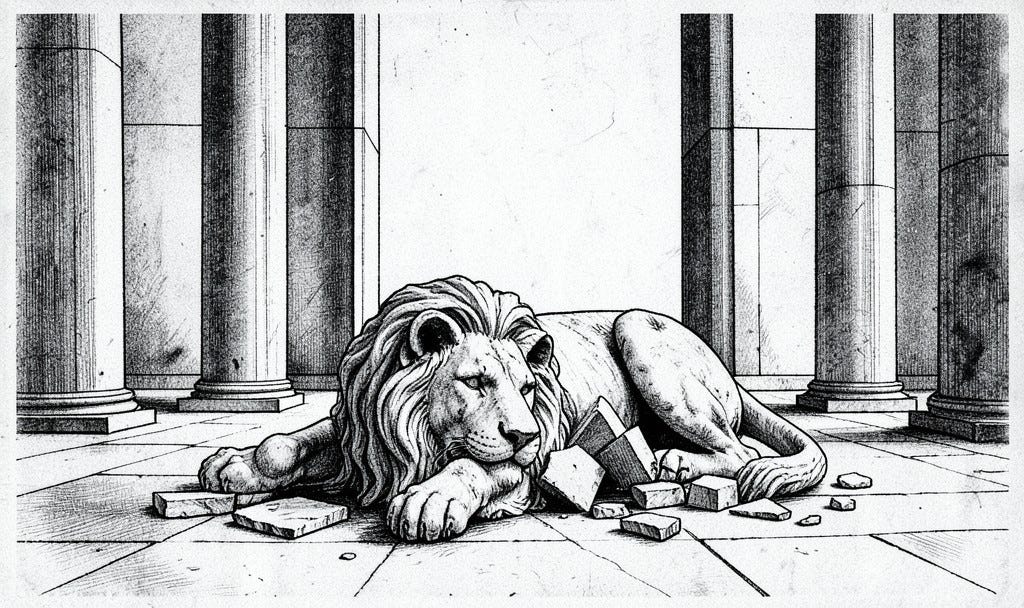
We have inherited a storytelling flaw that makes us dangerously easy to manipulate: we instinctively align our sympathies with the smaller figure in any given room.
From ancient folklore to modern cinema, the script is always the same. The giant is inherently malicious, lumbering, and corrupt, while the smaller challenger is automatically pure, righteous, and noble. It is a beautiful archetype for children’s stories, but when we import this exact aesthetic into the unforgiving reality of global geopolitics, it creates an intellectual disaster.
In our current cultural landscape, we have completely detached our moral judgements from actual ethics, intent, or behaviour. Instead, we have subbed in a crude, visual metric: whoever is stronger is the villain, and whoever is weaker is the victim.
This low-resolution framework has given rise to a bizarre psychological phenomenon where civilised societies are manipulated into cheering for their own destruction, simply because the forces arrayed against them look more chaotic, unorganised, and desperate. We have been trained to believe that weakness is a synonym for virtue, and that strength is a definitive proof of guilt.
To maintain this illusion, the modern activist apparatus has to carefully police how we look at institutional and state power. The moment a nation-state or an institution builds a functioning infrastructure—the moment it secures its borders, stabilises its economy, and develops a formidable defence system—it is cast out of the realm of human empathy. It becomes a Goliath. And in the modern secular religion of protest, a Goliath is never allowed to have a legitimate grievance, a valid fear, or a right to defend itself.
Consider what happens when a sophisticated, democratic society faces a crisis. If it uses its structural power to neutralise a threat, the action is immediately filtered through an aesthetic lens by distant spectators. The actual sequence of provocations is completely erased. The underlying values of the competing sides are ignored. All that matters to the watching crowd is the asymmetric distribution of force. The side with the better technology, the cleaner uniforms, and the more orderly system is automatically branded as an oppressor, regardless of what the opposing side actually believes or does.
This calculation completely ignores the reality that weakness can be just as tyrannical, dogmatic, and violent as unrestrained strength. By automatically granting a moral blank check to the underdog, Western onlookers end up funding and validating movements that openly despise the very liberties that allow those onlookers to protest in the first place. It is a form of selective solidarity that demands a stronger society apologise for its own survival, treating its competence as a moral failing.
If we want to rescue our public discourse from this emotional trap, we have to grow past the aesthetics of the colosseum. We have to learn to evaluate conflicts based on principles, actions, and foundational values, rather than who looks bigger on a television screen. Survival is not a crime, and institutional failure is not exclusive to the powerful. Until we find the courage to audit both the giant and the challenger with the same uncompromising standard of truth, we will continue to walk a path where our best intentions are weaponised to build a much darker world.
To explore how this visual trap shapes our view of modern state power—and to understand the dangerous psychological mechanisms that turn cultural success into a moral crime—pick up Book 3 of The Politics of Protest series: The Good Goliath.