


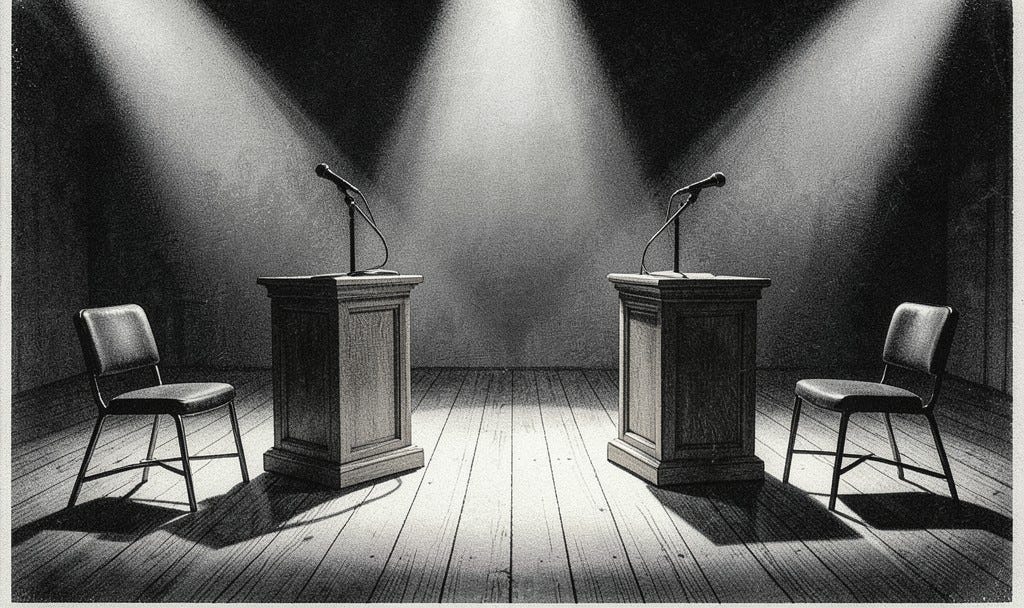
We live in an era obsessed with the spectacle of combat.
Every feed, podcast grid, and cable segment is packed with self-described intellectual gladiators promising to “destroy,” “demolish,” or “expose” an opponent. To anyone watching from the outside, it looks like a boom period for public discourse.
In practice, the opposite has happened.
The volume has exploded, but actual truth-seeking has quietly left the building. What passes for debate today isn’t an exchange of ideas; it’s performance art designed to enforce tribal solidarity. And until we look past the noise to understand how modern shouting matches are engineered, we’ll keep wondering why hundreds of hours of viral arguments yield zero real understanding.
In a functional intellectual disagreement, both sides operate with common ground: terms have stable meanings, evidence carries weight, and logic determines whose premise survives. The goal is simple: stress-test an idea until you find where it breaks.
In our captured cultural climate, that goal has shifted from discovery to moral excommunication.
When an ideologue sits across a table today, they aren’t interested in testing an argument against yours. They are setting a public trap. First, they strip your points of charity and context, rebuilding them into an absurd caricature that triggers instant audience outrage. Next, they redefine language mid-sentence, turning any refusal to adopt their newly minted vocabulary into an ethical failing. Finally, they demand total capitulation—repeat the tribal line verbatim, or be branded a heretic.
When a public figure chooses to walk away from that kind of circus, the crowd reflexively calls it cowardice. But refusing to participate in a rigged game isn’t a retreat. It’s a refusal to lend credibility to an asymmetric spectacle.
The paradox of modern public discourse is that the loudest proponents of “debate” are often the most terrified of genuine pushback. A modern shouting match is never meant to convince the person on the other side; it exists entirely to reassure the in-group. Publicly punishing a designated dissenter confirms the host’s status, burnishes their authority, and proves their purity to the tribe. It is brand management masquerading as philosophy.
When we cheer for these spectacles, we aren’t defending free speech. We’re funding polarization. If we want a culture that actually functions, we have to stop treating the public square like a colosseum and learn to recognize a theatrical loyalty test for what it is. True independence doesn’t just mean speaking your mind—it means refusing to read from the script.
This essay draws on the core ideas explored throughout my series, The Politics of Protest, examining how modern movements trade intellectual honesty for performative conformity:
The Age of Performance: Politics as Theatre — For more on how modern conflicts are reduced to performance art.
Truth Beyond Activism — A critical guide to selective solidarity and the bad-faith traps surrounding current geopolitics.
The Secular Salem — The foundational theory on how modern social crusades mimic historical witch trials.