


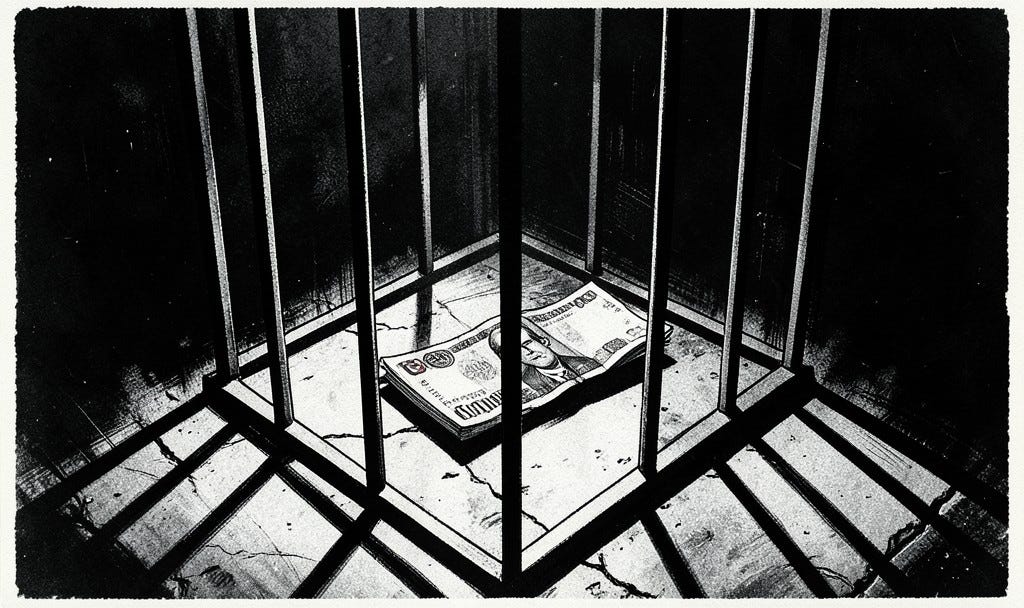
We are told that the death of cash is merely the natural triumph of convenience.
A tap of a phone, a facial recognition scan at a turnstile, a seamless frictionless swipe—modern life has systematically eliminated the mechanical nuisance of paper notes and metal coins. Commercial banks shut down local branches, retail shops hang “card only” signs, and central bankers speak in hushed, reverent tones about the hygienic efficiency of Central Bank Digital Currencies (CBDCs).
The sales pitch is always identical: cash is slow, cash is expensive to handle, and cash is the preferred currency of tax evaders, money launderers, and black-market cartels. Surrendering it, the public is assured, is simply the admission fee for entering a frictionless digital future.
What is left unsaid is far more consequential: cash is the only form of money that does not require an active permission slip to spend.
When you strip money of its tangible, bearer-instrument reality, you do not simply upgrade a payment system. You fundamentally alter the balance of power between the sovereign individual and the administrative state. The war on physical currency is not an operational reform; it is the construction of an automated compliance grid from which there is no physical exit.
The Architecture of Intermediation
To understand the peril of a purely digital economy, one must understand the shift from ownership to access.
When you hold a twenty-pound or fifty-dollar bill in your hand, you hold physical property. The transaction between you and another party is peer-to-peer, final, and instantaneous. It leaves no telemetry. It generates no metadata. Most importantly, it requires no corporate or political intermediary standing between the buyer and the seller, deciding whether the exchange meets acceptable behavioural standards.
Digital currency operates on the inverse principle. You do not hold money in a commercial bank account; you hold an unsecured claim against a private financial institution. Every transaction is an interceded petition:
You request a transfer.
The payment rail (Visa, Mastercard, SWIFT) routes the request.
Automated compliance algorithms inspect the transaction against regulatory databases, AML algorithms, and reputational risk parameters.
If permitted, the ledger updates.
Physical money remains the final buffer against total surveillance. To understand how every transaction feeds the wider surveillance apparatus, see the breakdown on The Digital Panopticon.
In a mixed economy where cash remains an accessible baseline, this intermediation is a manageable risk. If a payment processor acts arbitrarily, cash remains the sovereign fail-safe.
The moment cash is legislated, taxed, or phased out of practical existence, the intermediary becomes the absolute sovereign.
De-banking: The Silent Excommunication
For decades, the public believed that censorship was something carried out by courts, censors, or uniformed police tearing down pamphlets. That model is antiquated.
In a modernised, ledger-based society, the state does not need to send police to your front door to silence your ideas. It does not need to ban your books or pass unconstitutional statutes against your speech. Such measures are loud, legally contested, and visually ugly; they create martyrs.
The modern method is bloodless, quiet, and administrative: financial de-banking.
We have already seen the blueprint deployed across Western democracies:
The Canadian Precedent: In 2022, the Canadian federal government invoked emergency economic measures to freeze the bank accounts, insurance policies, and digital payment access of peaceful truck convoy protesters—and individuals who merely donated fifty dollars to support them—without a single court order or criminal charge.
The Reputation Clause: Across the UK and Europe, political dissidents, contrarian journalists, and populist politicians have repeatedly found their personal and business bank accounts unilaterally terminated under vague “reputational risk” policies enforced by retail banks.
Payment Processor Blacklisting: Private payment gateways routinely terminate services to independent writers, alternative media platforms, and controversial legal defence funds, acting as de facto speech regulators under the guidance of state administrative bodies.
When your ability to buy groceries, pay heating bills, or purchase medicine depends entirely on continuous access to a digital ledger, access to capital ceases to be a property right. It becomes a temporary behavioural license.
Speech is only as free as your ability to finance your basic existence without state approval.
Central Bank Digital Currencies (CBDCs): Programmable Obedience
If private commercial de-banking represents the prototype, Central Bank Digital Currencies represent the industrialised end state.
Unlike traditional bank deposits or independent decentralised cryptocurrencies, a CBDC is direct central bank liability paired with programmable software. It introduces capabilities that authoritarian regimes throughout history could only dream of:
Geographic Restrictions: Money programmed to be spendable only within a specified radius or designated postal zone.
Product Limitations: Dynamic restrictions capping expenditures on fuel, airline travel, meat, or specific political materials under the guise of ecological rationing or public health mandates.
Expiration Dates: Balances designed to decay or disappear if not spent within an arbitrary time window, destroying the fundamental human ability to accumulate independent generational savings.
Instantaneous Seizure: The immediate, automated freezing of assets for anyone flagged by automated administrative audits, eliminating the procedural friction of warrants or judicial due process.
Under a CBDC framework, the state no longer needs to persuade you to follow its policies. It simply alters the code that dictates what your money is allowed to do. Obedience is built directly into the currency’s execution layer.
The Last Bastion of Non-Compliance
The elimination of physical currency is marketed as an inevitable evolution of commerce. In truth, it is the closing of the frontier.
Historically, freedom was not guaranteed solely by laws on parchment; it was guaranteed by the physical limits of the state’s reach. There was always a margin of illegibility. You could keep savings in a physical strongbox, settle accounts quietly with a neighbour, or step away from an institutional system that demanded your intellectual capitulation.
Cash preserves that essential margin. It is private, resilient to network outages, immune to cyber-collapse, and stubbornly analog. It allows individuals to trade, build, and survive without reporting their every movement to an algorithm.
The push toward a cashless society is not a crusade for efficiency; it is an administrative campaign to eliminate the final exit door. Once physical money is eradicated, total compliance is no longer a political demand—it is the default operational reality.
(If you found this analysis valuable, subscribe to receive regular essays directly to your inbox. To explore the narrative fiction exploring how individuals survive when stepping off the digital grid, read ØFF GR1D.)