


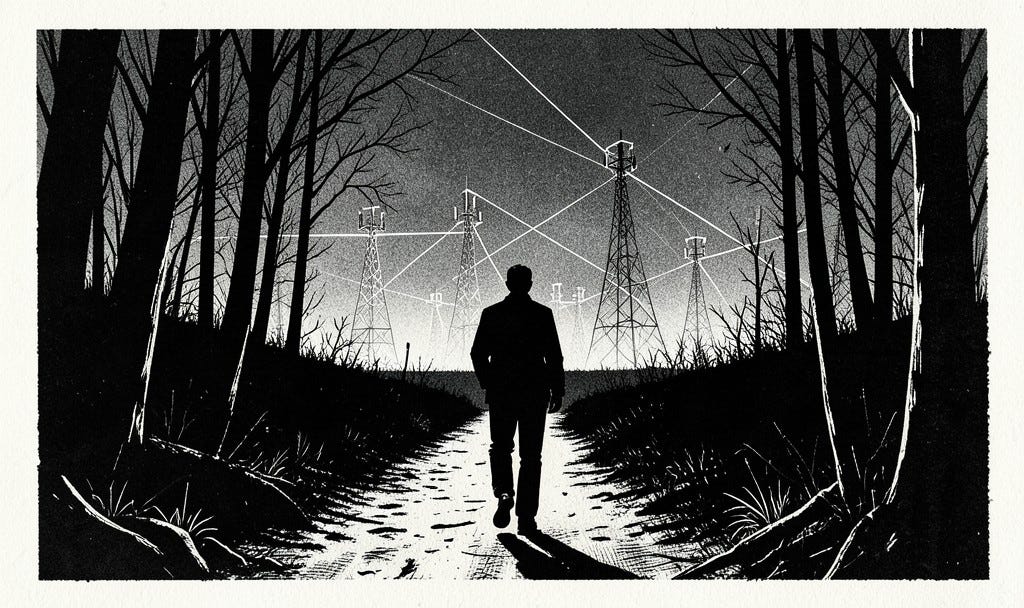
Not long ago, leaving your past behind was an ordinary part of the human experience.
If a man made a mess of his life, fell out with his village, or ran into debt, he could walk three towns over, take up an apprenticeship under an assumed trade, and build a quiet life. The world was slow, physical, and profoundly forgetful. Documents were handwritten sheets of vellum kept in tin boxes that flooded, burned, or were simply lost when a clerk retired. Oblivion was the default setting of history.
Today, society has abolished the clean slate.
We live inside an architecture designed never to forget a single detail. Every card swipe, location ping, search query, and administrative form is logged, timestamped, and backed up across mirrored server farms. It is marketed as convenience, security, and smart civic management. In reality, it is a permanent digital ledger that follows you from cradle to grave.
The Architecture of Total Recall
The danger of this system isn’t merely that governments and private contractors hold mountains of data on you. It is that the data is completely static, while human beings are not.
People change their minds, outgrow foolish opinions, and make mistakes. But an algorithmic profile doesn’t understand context, maturity, or remorse. It only understands tokens in a database.
When your identity is entirely digitised, you are permanently tethered to every transaction you have ever made. A private platform or a state agency can pull up your digital footprint from a decade ago to deny you credit, flag your travel credentials, or revoke your merchant account under vague terms of service. You are never judged as the person standing in the room today; you are judged by the cold aggregation of your past metadata.
Forgiveness requires forgetting. A society that records everything is fundamentally incapable of grace.
The Panopticon Without Walls
Historical prisons required stone ramparts, barbed wire, and watchtowers because the inmates had bodies that could slip over a wall.
The modern surveillance perimeter doesn’t need physical walls. It operates entirely through administrative choke points.
If you cannot open a bank account without a digital identity profile, you cannot trade. If you cannot board a train or a flight without a facial scan, you cannot travel. If your health records, credit score, and communication logs are linked to a single biometric credential, stepping out of line doesn’t land you in a dungeon—it simply shuts down your ability to participate in modern society.
You remain technically free to walk down the street, but you are functionally immobilised. The cage is invisible, quiet, and impossible to scale because it is made of software.
Stepping Off the Ledger
Most political debates about privacy remain comfortably abstract. Academics and commentators write papers about regulatory frameworks, GDPR updates, and digital civil liberties.
Yet none of those papers answer the real, physical question: what does an ordinary person actually do when the perimeter closes in completely?
What does daily survival look like when you decide that the price of modern convenience is far too high? How do you buy food without leaving a trace? How do you heat a room when the grid requires an active login? How do you travel without your face pinging half a dozen cameras before you reach the motorway?
That question pushed me past theoretical essays and straight into the narrative of ØFF GR1D. I wanted to strip away the academic jargon and examine the raw, physical reality of evasion: the exhausting, gritty trade-offs demanded of someone who refuses to be logged into the master database.
Living outside the system isn’t a romantic daydream. It is hard, high-friction work. But as modern institutions continue to turn everyday human existence into a permanent audit, the ability to disappear may soon be the only real freedom left.
(If you found this audit valuable, consider subscribing to receive regular essays straight to your inbox. You can also explore my full collection of books on culture, institutional power, and autonomy on the site.)