


Few slogans perform better at dinner parties or on political placards than demanding that the rich simply “pay their fair share”.
It is a seductive moral framework. It presents the funding of modern public infrastructure not as an intricate mechanical balance of incentives, capital flows, and demographic pressures, but as a straightforward melodrama. Society is suffering, the argument goes, because a handful of oligarchs refuse to hand over their hoard. Pass another levy, raise the top marginal rate, tax net wealth, and the hospitals will suddenly run on time.
It is pure theatrical politics. More importantly, it relies on a complete refusal to examine how modern tax systems actually operate, who currently keeps the lights on, and what happens when capital decides to walk.
The Narrow Pillar
The most curious aspect of the “fair share” crusade is the assumption that high earners are somehow evading the fiscal heavy lifting.
Look at the arithmetic in Italy, which reflects the broader fiscal structure across most European welfare states. Data from the Ministry of Economy and Finance and independent fiscal observatories reveals a reality almost entirely unrecognised by the activist class: less than 15% of Italian taxpayers—those earning above €35,000 gross per year—fund roughly two-thirds of all personal income tax (IRPEF).
If you narrow the focus further to those earning above €50,000, roughly 6% of the population pays over 40% of the entire personal income tax revenue.
At the other end of the ledger, nearly half of all registered taxpayers declare incomes so low that their combined contribution amounts to barely 5% of total income tax receipts. Yet every one of those citizens naturally relies on state pensions, subsidised transport, public schooling, and universal healthcare.
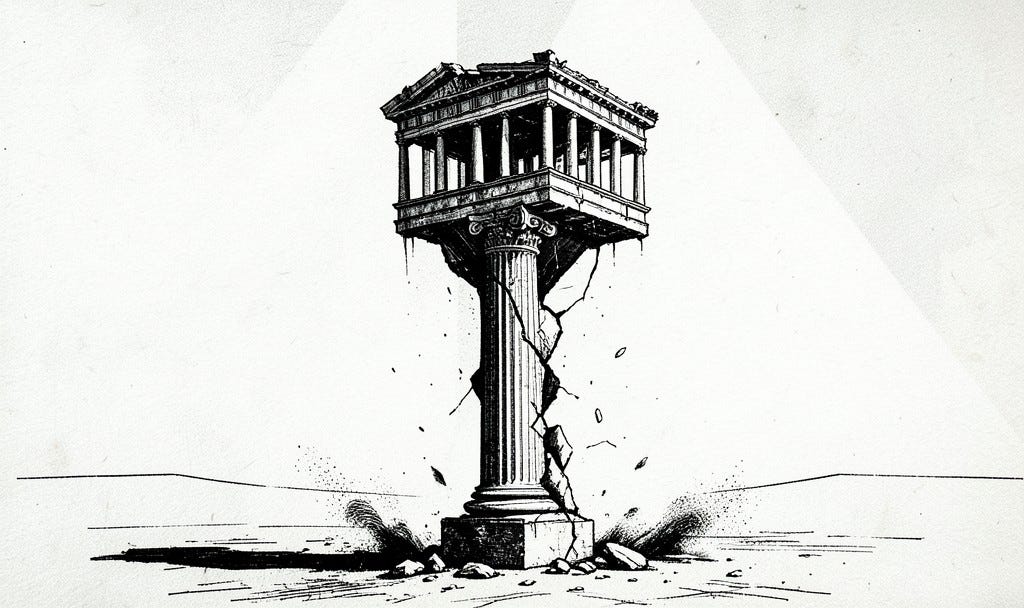
The modern welfare state does not rest on a broad, shared civic foundation. It rests on a dangerously narrow pillar of middle-to-high income professionals, managers, and entrepreneurs. The system is already hyper-progressive. The productive minority is already carrying the rest of the country on its back.
The Unused Safety Net
There is an added irony that moral crusaders rarely acknowledge: the people contributing the lion’s share of tax revenue are frequently the ones who use the least amount of state services.
A household paying €40,000 or €80,000 a year into the national treasury rarely waits eight months for an ultrasound at a regional public clinic. They purchase private medical insurance or pay out-of-pocket at independent clinics. They pay substantial local municipal taxes while often relying on private transport and independent services.
They are, in practical terms, the ideal civic patrons: they fully subsidise state schools, emergency wards, and public transit systems for their fellow citizens, while asking virtually nothing in return from the day-to-day public infrastructure.
To turn around and lecture this demographic that they are selfishly withholding their duty is not just bad economics. It is a profound breach of the social contract.
The Myth of Captive Capital
The central flaw in modern wealth tax proposals is the childish belief that capital is static.
Activists imagine money as a physical pile of gold coins sitting in a vaulted basement, waiting patiently for a government bureaucrat to scoop it into a burlap sack. In the real world, capital is liquid, international, and profoundly sensitive to incentives.
Every historical attempt to impose punitive wealth levies proves the exact same lesson:
The French Debacle: When France enforced its Solidarity Tax on Wealth (ISF), an estimated 42,000 millionaires fled the country over a fifteen-year period. The French government took in roughly €3.5 billion annually from the levy, but studies revealed the capital flight cost the broader economy upwards of €7 billion a year in lost VAT, corporate tax, and private investment. Emmanuel Macron was eventually forced to abolish it in 2017 simply to halt the bleeding.
The Norwegian Exodus: In 2022, Norway raised its municipal and state wealth taxes by a modest fraction of a percent. The immediate result was a mass migration of top wealth creators to Switzerland, taking tens of billions of Norwegian kroner out of the domestic economy and wiping out far more revenue than the new tax rate was projected to collect.
Internal Domestic Flight: You do not even need an international border. Within the United States, states like California and New York that raised levies on top earners witnessed an immediate, documented exodus of high-net-worth residents and corporate headquarters to zero-income-tax states like Florida and Texas.
You cannot tax capital that is no longer there. When you push past the tolerance threshold, high earners do not organise protests or write angry pamphlets. They simply ring their wealth managers, buy a plane ticket, and move their fiscal residency.
And when the wealth creators leave, the bill for maintaining the hospitals doesn’t vanish—it falls square on the shoulders of the ordinary workers who cannot afford to move.
The Real Fiscal Black Hole
Focusing obsessively on taxing the wealthy is also a deliberate distraction from the real structural problem: pervasive, low-level non-compliance.
In Italy, the genuine fiscal void is not offshore billionaire trusts; it is widespread, everyday informal trade. Official reports on the tax gap consistently put Italy’s annual evaded revenue near €80 to €90 billion. The vast bulk of that deficit does not come from multinational corporations using legal tax optimisation. It comes from the unrecorded cash economy—the un-invoiced tradesman, the untaxed home repair, the cash-in-hand service provider, and the unprinted retail receipt.
Ten euros evaded by ten million people hollows out public hospitals just as effectively as a single large avoidance scheme. But confronting millions of ordinary voters about paying their proper share at the counter is politically lethal.
It is far easier for politicians to point an accusatory finger at a handful of wealthy figures, pretend that confiscating their property will solve an eighty-billion-euro structural hole, and dodge the hard administrative reality.
The Invoice Remains
Real fairness does not mean treating high productivity as a crime to be punished until the engine stops running.
A viable welfare state requires two things: a broad, reliable tax base where everyday compliance is expected from everyone, and an economic climate that encourages wealth creators to stay, invest, and build.
Pumping up tax rates on the minority who already pay for almost everything is not justice. It is administrative cannibalism. You can indulge in the rhetoric of class envy for only so long before the producers walk out the door, the ledger collapses, and everyone else is left holding the empty bag.
(If you found this audit valuable, subscribe to receive essays directly to your inbox. Explore the full catalogue of books dismantling institutional myths and modern orthodoxies under the Books tab on the site.)