


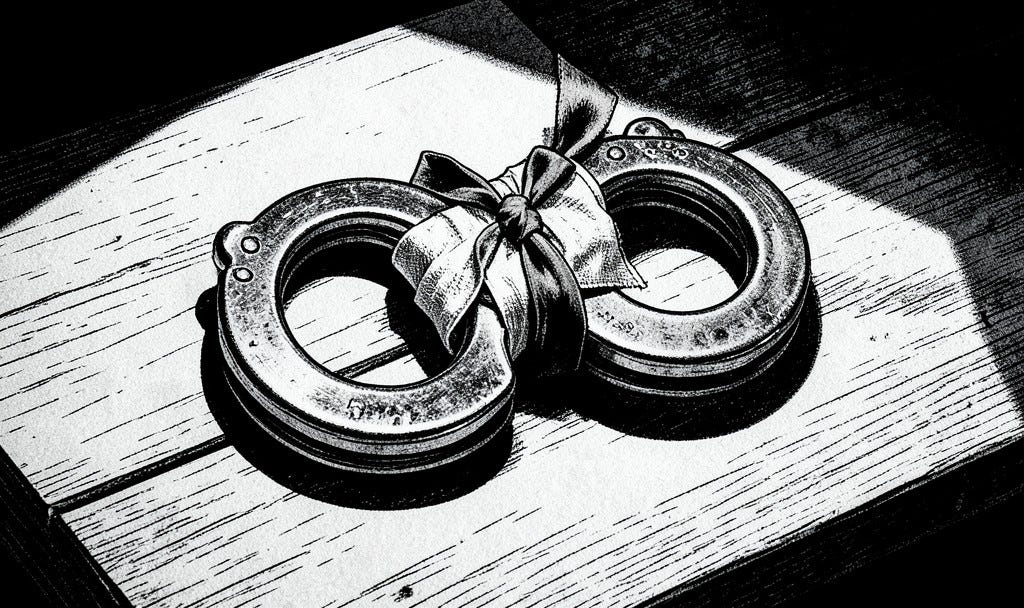
Old-fashioned tyranny was loud and theatrical. It announced itself with banners, iron gates, and armed guards in the public square. The old tyrant worked on basic fear: follow the order, or suffer the consequences.
Because we associate tyranny only with soldiers and noisy decrees, we tend to believe modern democracies are safe from control. We assume that if our liberties were ever truly threatened, the danger would arrive in uniform, carrying a rifle and demanding obedience.
It does not. Modern control does not talk about conquest or dominion. It speaks the language of hygiene, therapy, and maternal care.
The quickest way to dismantle basic freedom today is not through terror. It is through our own safety reflex.
The Promise to Remove All Pain
Every society organises itself around what it values most. For generations, open societies put individual liberty, honest debate, and personal autonomy near the top. Being safe mattered, of course, but it was balanced against the simple reality that human beings need room to take risks, make poor choices, and learn from them.
Over the past few decades, that order was quietly turned on its head. Safety stopped being a practical baseline and became the ultimate moral virtue.
In a society that values freedom, risk is the price of admission. You assume that your neighbours are adults who can make mistakes, read sharp opinions without crumbling, and handle daily challenges on their own. But when total safety becomes the only acceptable standard, ordinary life suddenly looks dangerous. Because a government can never completely stop bad things from happening, its authority must keep growing to police every single detail of human life.
When safety becomes non-negotiable, ordinary independence starts looking like dangerous negligence.
Expanding the Definition of Danger
To justify constant monitoring, the meaning of harm had to stretch far beyond broken bones and physical violence.
The playbook was simple: treat emotional discomfort as a genuine physical threat. Disagreeable opinions were branded as hate. Difficult debates became toxic misinformation. Challenging political ideas were treated as public health crises that might destabilise the community just by existing.
Once you accept that words work like viruses, shutting down speech stops looking like censorship. It starts looking like basic cleanliness.
When disagreement is reclassified as emotional harm, public discourse demands performative compliance. This mechanism is examined in detail in The Performance of Purity.
Banning a writer, closing a bank account, or scrubbing an awkward debate from the internet is no longer seen as crushing open inquiry. Instead, it is praised as a helpful intervention to keep people healthy. The censor no longer sees himself as an enforcer. He sees himself as a nurse keeping the room sterile.
The State as Overprotective Parent
The real power of governing through care instead of brute force is that it disarms criticism.
If someone orders you about at gunpoint, you know exactly who your opponent is and you naturally resist. But when an administrative panel restricts your work, watches your speech, or limits where you can travel to protect vulnerable neighbours, pushing back feels cruel. Anyone who asks questions is treated not as someone defending basic rights, but as a selfish troublemaker who simply does not care about other people.
The state quietly steps into the role of an anxious parent managing a chaotic nursery. Citizens are treated like delicate children who cannot be trusted with adult decisions.
This control does not need prison walls. It works through quiet nudges: automated filters on your social feed, payment systems that switch off without explanation, and terms of service that update overnight. There are no dramatic protests or dramatic showdowns. There is only the low, steady hum of bureaucratic management.
The Trap of the Padded Cell
A world completely obsessed with safety cannot stay free. Real life is inherently messy, unpredictable, and full of friction. It requires the right to stumble, the room to disagree, and the patience to live alongside people whose opinions might offend you.
When we surrender basic liberties in return for guaranteed protection, we do not end up truly safe. We simply trade small, manageable risks for the absolute power of an administrative system that can never be questioned.
A padded cell lined with soft cushions and safety rules is still a cell. The real tragedy is that we walked inside, shut the latch ourselves, and thanked the guards for keeping us out of harm’s way.
(If you found this audit valuable, subscribe to receive regular essays straight to your inbox. You can also explore my books on institutional power and modern culture on the site.)