For months, the dominant online narrative surrounding Gaza has rested on a singular, unyielding accusation: that Israel is orchestrating a deliberate, state-engineered starvation campaign. Across social media, images of catastrophic famine are shared to advance accusations of genocide.
Yet, a closer look at verified data, logistical reports, and actual local business activity exposes a far more complex reality. While the war has caused widespread displacement and hardship, the absolute claim of an engineered famine collapses when confronted with what is actually happening on the ground—from open dessert parlours operating in Gaza City to the armed cartels controlling the distribution of food.
The Visual Contrast: Gaza’s Open Eateries
While media reports often depict a total absence of food, local Gazan commercial establishments continue to trade, market, and serve customers.
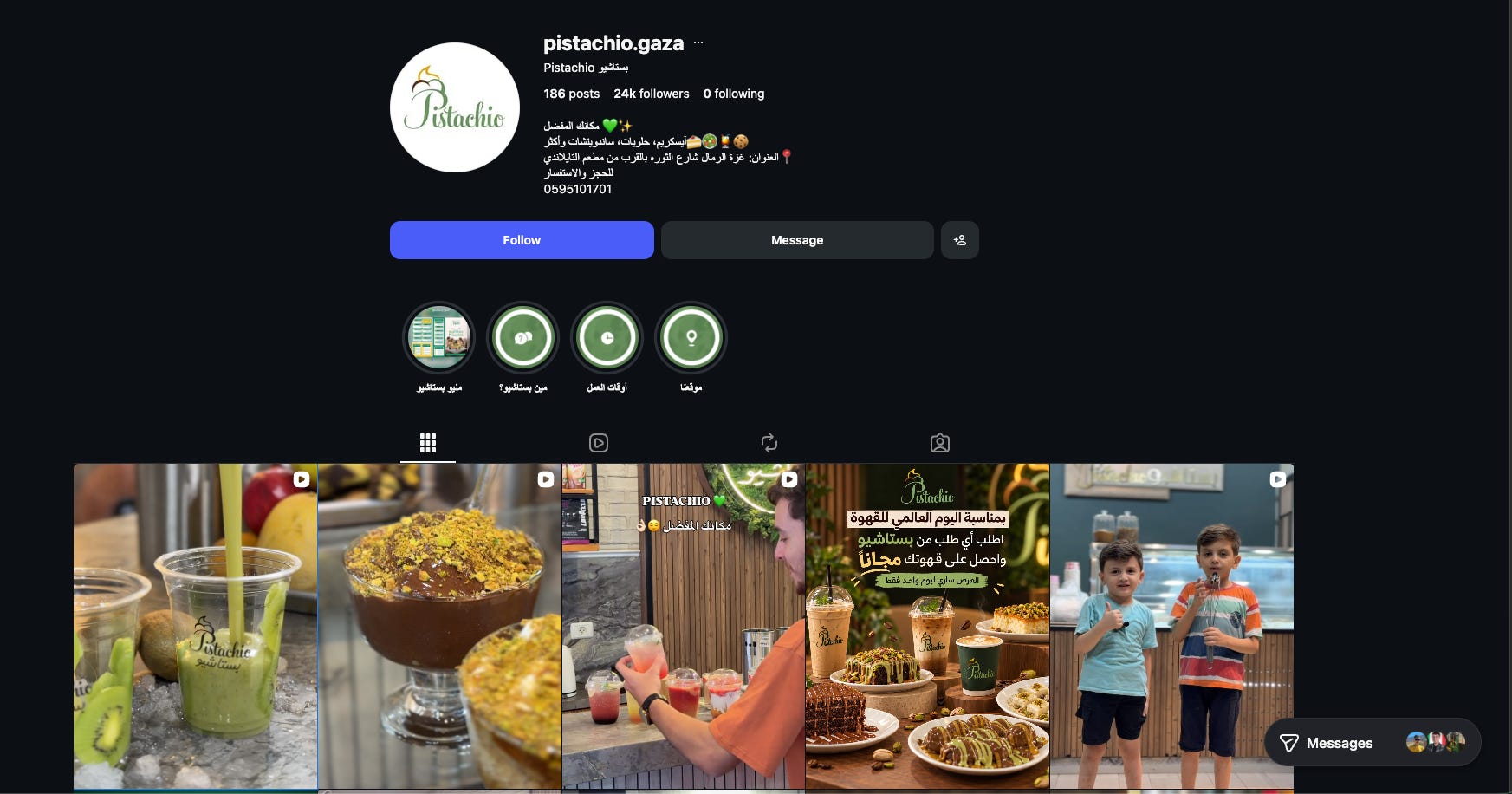
Pistachio (@pistachio.gaza): Located in the Rimal district of Gaza City, Pistachio is an active café and dessert parlour. Its social media channels show a functioning storefront offering iced lattes, pistachio-topped desserts, smoothies, and baked goods to local patrons.
Caption: Gaza City café and dessert parlour ‘Pistachio’ (@pistachio.gaza) promoting iced coffees, desserts, and smoothies.
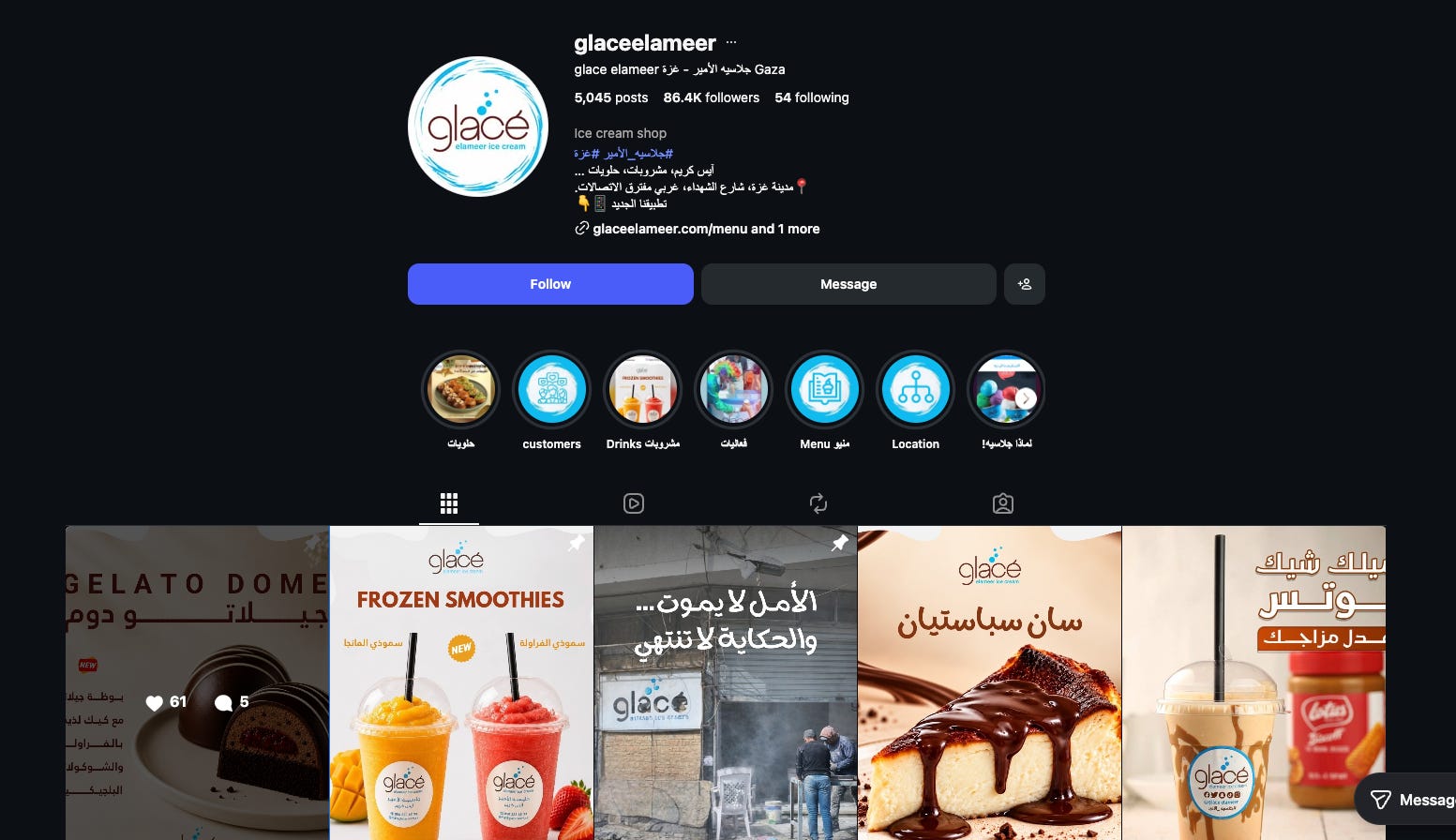
Glace El Ameer (@glaceelameer): Located along Al-Shuhada Street in Gaza City, this longstanding ice cream and confectionery shop continues to operate. Even when operating from damaged or makeshift shopfronts amidst the rubble, its feeds feature layered cakes, frozen smoothies, and chocolate desserts.
Caption: Confectionery and ice cream shop ‘Glace El Ameer’ (@glaceelameer) in Gaza City advertising frozen treats and baked goods.
These businesses are not isolated fabrications, nor do they signify an absence of conflict. Instead, they illustrate a stark truth: goods and ingredients are present and moving through commercial channels, defying the narrative that the territory is an airtight wasteland devoid of sustenance.
The Real Bottleneck: Armed Hijacking and Black-Market Siphoning
If supplies, flour, and raw ingredients are entering Gaza, why do severe shortages and nutritional distress persist among ordinary civilians? The answer lies not at the border crossings, but inside the Strip itself.
Logistical records from border authorities confirm that hundreds of tonnes of humanitarian supplies enter inspection terminals daily. However, international relief organisations—including the UN World Food Programme (WFP) and OCHA—have repeatedly documented what they term “systematic, criminal looting.”
Once relief trucks clear Israeli inspection points, they enter an internal security vacuum. Armed Hamas operatives and affiliated gangs routinely intercept convoys at gunpoint. Rather than allowing free humanitarian aid—flour, cooking oil, tinned goods, and infant nutrition—to reach official community kitchens or vulnerable displaced families, armed factions divert truckloads into private warehouses.
Profiting from Deprivation
The diverted aid does not vanish; it is redirected into the underground economy. Free international aid stamped with UN emblems regularly appears on open-air market stalls where civilians are forced to purchase basic sustenance at markups ranging from 500% to 1,000% of pre-war prices.
Independent Arab reporting and local testimonies confirm that Hamas’s internal security units actively protect these black-market supply lines while violently suppressing local tribal councils or merchant committees attempting to distribute aid independently. For an entrenched insurgency, controlling food is a dual-purpose strategy: it provides a lucrative revenue stream through artificial scarcity and serves as an instrument of social subjugation, ensuring the civilian population remains entirely dependent on armed patronage.
Deconstructing the Slogan
To acknowledge these facts is not to diminish the real suffering of civilians caught in a war initiated by Hamas on 7 October. It is, however, an essential corrective to malicious propaganda.
The tragic destruction in Gaza is the product of urban combat fought against an enemy that deliberately embeds its fighters and command bunkers beneath residential homes. Accusing Israel of deliberate starvation ignores the thousands of tonnes of aid delivered, misrepresents the findings of international food security monitoring bodies, and covers for the armed groups who steal food from the mouths of their own people to profit on the black market.
This video discusses the widespread circulation and subsequent platform moderation of content featuring open cafés and restaurants in Gaza, highlighting the debate over online portrayals of food availability.