


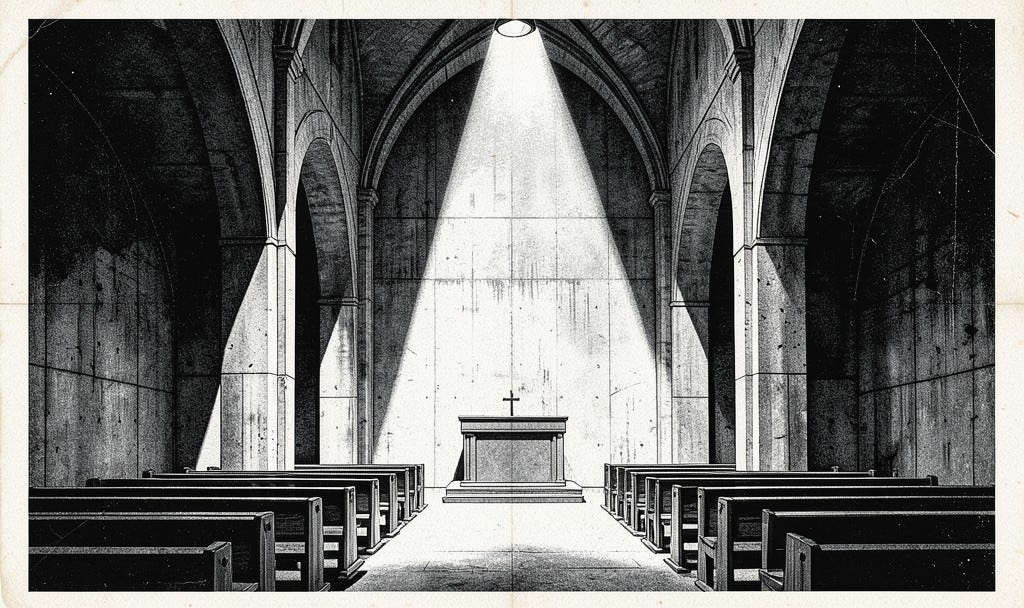
We like to believe we are living in a thoroughly secularised world. We look at declining church attendance, the retreat of traditional religious institutions from public life, and the rise of a highly credentialed, scientifically minded intellectual class, and we conclude that the ancient human impulse toward faith has finally been outgrown.
But this is a profound misunderstanding of human psychology. When a society walks away from a traditional temple, it doesn’t lose its need for a temple. It simply builds a new one using the materials available in the modern world.
If you look closely at the modern progressive activist apparatus, you will quickly realise that it is not a novel political philosophy. It is a deeply religious framework that has meticulously borrowed, adapted, and re-engineered the classic mechanics of the historic church. It has simply swapped the supernatural deity for a cultural orthodoxy, trading spiritual salvation for a highly performative social purity.
The parallels are not metaphorical; they are structural. Every functioning religion requires a foundational narrative of human brokenness, and modern progressive activism found its version in the concept of systemic privilege. This serves as the new original sin—a stain you are born with, inherited purely by the circumstances of your birth, which influences your entire existence regardless of your personal character or intentions.
But whereas traditional faiths offer a clear, structured mechanism for grace, confession, and ultimate redemption, the secularised church of the left offers no such baseline. In this new paradigm, your original sin can be acknowledged, managed, and publicly lamented, but it can never be fully washed away. Confession doesn’t lead to absolution; it merely establishes a baseline of perpetual indebtedness to the orthodoxy.
Because there is no mechanism for grace, the social ecosystem becomes intensely punitive. The public square has been redesigned around the mechanics of the heresy trial. We see this play out in the ritual of public cancellation, which functions identically to historical excommunication. When an individual steps outside the shifting boundaries of the linguistic dogma, they are not met with an intellectual counter-argument. They are met with a moral purge. They are stripped of their professional standing, socially isolated, and cast into the outer darkness to protect the ideological purity of the community.
Even the daily habits of the activist class mirror traditional liturgy. The adoption of rapidly evolving vocabulary codes, the public reading of institutional statements of compliance, and the synchronised chanting of slogans at mass gatherings are all liturgical acts. They exist to signal tribal belonging, reinforce the authority of the managerial priesthood, and terrify the broad-minded middle into absolute silence.
We haven’t actually advanced past the psychological traps that drove the historic witch trials or the grand inquisitions of our past. We have merely digitised the scaffolding and updated the vocabulary. Until we recognise that our public square is being captured not by a political movement, but by a rigid, secularised theology that weaponises our best intentions to demand absolute submission, we will continue to watch our liberties get sacrificed on the altar of a new conformity.
To explore how this cycle of moral panic and institutional overreach keeps repeating—and how modern movements weaponise our innate desire for goodness to police the boundaries of human thought—pick up a copy of my foundational book: The Secular Salem: The Cost of Moral Idealism in a Complex World.